


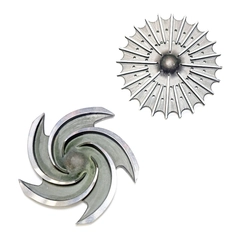
Image shown may not be actual product

385-00110-6850
Pumpworks 385-00110-6850 ANSI Process Pump Repair Parts, IMPELLER, 6RV, 2X3X6,G1,HB. Group 1, Type 6RV, HB Material, 2 x 3 x 6 Pump Size.
- Overview
- Series Info
- Reviews
385-00110-6850
Pumpworks 385-00110-6850 ANSI Process Pump Repair Parts, IMPELLER, 6RV, 2X3X6,G1,HB. Group 1, Type 6RV, HB Material, 2 x 3 x 6 Pump Size.
| Group | Group 1 |
| Material | HB |
| Part Type | Impeller |
| Pump Size | 2 x 3 x 6 |
| Quick Specs | IMPELLER, 6RV, 2X3X6,G1,HB |
| Type | 6RV |
Impellers Information
Knowing exactly when to pull a pump from service to replace the impeller can save you from a catastrophic shaft or seal failure. While some signs are obvious, others require a bit of "detective work."
Here are the four primary triggers for an impeller replacement:
1. Visual "Wear & Tear" Indicators
During a routine maintenance teardown, you should replace the impeller if you see:
Pitting or "Swiss Cheese" Appearance: This is a classic sign of cavitation. If the metal looks like it has been eaten away, the structural integrity is gone, and the impeller will eventually shatter.
Thinning Vanes: If the leading edges of the vanes are worn thin (knife-edged), they can no longer move fluid efficiently and are prone to snapping under pressure.
Abrasive Scoring: Deep grooves on the shroud or vanes from pumping solids will cause turbulence and massive efficiency loss.
2. Performance-Based Triggers
You don't always need to see the impeller to know it's failing. Watch your gauges for:
Loss of Head or Flow: If your pump is running at the same RPM but you’re seeing a 10–15% drop in discharge pressure or flow rate, the impeller-to-casing clearance is likely too wide, or the impeller has worn down.
Increased Power Consumption: As an impeller wears, it becomes less efficient. If your motor is drawing more Amps than usual to do the same amount of work, the impeller is likely the culprit.
Unexplained Vibration: A worn or chipped impeller becomes unbalanced. This creates vibration that will quickly destroy your mechanical seals and bearings.
3. The "Adjustment Limit"
One of the best features of PumpWorks ANSI pumps is the external impeller adjustment.
When to replace: You can move the impeller forward to "reset" the clearance as it wears. However, once you have adjusted it as far as it can go and the clearance is still over 0.015"–0.030" (depending on the model), the impeller has lost too much material and must be replaced.
4. Process Changes
Sometimes the impeller is physically fine, but the "job" has changed.
Trim Diameter: If your process requirements have changed (e.g., you need less flow or head), it is often cheaper and more efficient to replace the current impeller with a precision-trimmed impeller rather than throttling a valve and wasting energy.
Maintenance "Rule of Thumb"
The 10% Rule: If the cost of repairing/machining an old impeller exceeds 50% of the cost of a new one, or if the impeller diameter has worn down by more than 10%, replace it. With PumpWorks' standard Carbon Steel, you often have the option to weld-repair, but for critical high-speed applications, a new, factory-balanced impeller is always the safer bet.
Do you have a pump currently showing symptoms like high vibration or low pressure? I can help you troubleshoot if it's the impeller or something else (like a suction leak).
Categories
Basic Petrochemicals
7583 productsFood & Beverage Services
23601 productsIndustrial
30503 products
Manufacturing
30503 productsMining
30503 productsOil & Gas
30503 productsPulp & Paper
30503 productsWaste Transfer
681 products


HD Product Demos & More
Stay tuned for releases of new product reviews and videos on our YouTube channel!
Follow Us and Save
Check our Social Media for new product announcements and exclusive specials for our followers.
Secure Online Shopping
We take your privacy and security serious. Feel safe when shopping in our online marketplace.





0 Reviews
Add a Review
You need to sign in to add a review.