


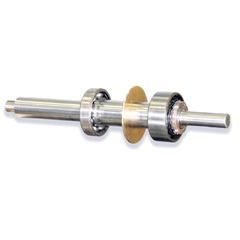
Image shown may not be actual product

436-00100-4404
Pumpworks 436-00100-4404 ANSI Process Pump Repair Parts SLEEVE, SHAFT, G1, A20, Group 1, A20 Materials.
- Overview
- Series Info
- Reviews
436-00100-4404
Pumpworks 436-00100-4404 ANSI Process Pump Repair Parts SLEEVE, SHAFT, G1, A20, Group 1, A20 Materials.
| Group | Group 1 |
| Material | A20 |
| Part Type | Shaft Sleeve |
| Quick Specs | SLEEVE, SHAFT, G1, A20 |
Shafts & Sleeves Information
Because the shaft and sleeve assembly is the "spine" of your pump, waiting until it breaks usually means you’re also buying a new mechanical seal, a set of bearings, and potentially a motor coupling.
Here is the professional guide on when to move from "inspection" to "replacement."
1. The "Seal Failure" Rule
If you are experiencing repeat mechanical seal failures (e.g., a seal that should last two years is failing every three months), the shaft is the primary suspect.
The Culprit: Even if the shaft looks straight to the naked eye, a microscopic bend (run-out) or "shaft whip" during operation will open the seal faces, causing a leak.
When to Replace: If dial indicator testing shows a run-out of more than 0.002" (0.05mm) at the seal face, the shaft is toast.
2. Sleeve "Grooving" or Scoring
The shaft sleeve is a wear part. You should replace it during every mechanical seal change if you see:
Visible Tracking: Any groove or "ring" worn into the sleeve where the seal sat. Even a scratch you can feel with a fingernail is enough to prevent a new seal from seating correctly.
Pitting: If there is corrosion under the area where the O-ring sits, the sleeve can no longer provide a secondary seal, leading to "leaking under the sleeve."
3. "Fretting" Under the Bearings
During a teardown, inspect the areas where the bearings sit on the shaft.
When to Replace: If you see "fretting" (a reddish-brown, sand-like residue) or if the bearing feels loose on the shaft, the shaft diameter has worn down. A bearing must have a precise press-fit; if it slips or spins on the shaft, it will generate heat and lead to a catastrophic seizure.
4. Keyway "Rolling"
In high-torque applications or pumps that have suffered a "hard start" or jam:
When to Replace: Inspect the keyways at both the impeller end and the coupling end. If the edges of the keyway are rounded, "rolled," or cracked, the shaft's structural integrity is compromised. This is a common precursor to the shaft snapping entirely.
Replacement Strategy: Part vs. Assembly
| Scenario | Best Replacement Choice |
| Routine Maintenance | Sleeve only. It’s cheap insurance to ensure the new seal lasts. |
| Corrosion on Shaft | 316SS Shaft Upgrade. Switch from 4140 to PumpWorks 316SS to stop the rust. |
| Bent Shaft / Seized Bearings | Complete Power End. By the time you press off old bearings and true a shaft, the labor cost exceeds the cost of a pre-assembled PumpWorks Power End. |
Pro-Tip: The "Hidden" Replacement Trigger
If you are currently using Ductile Iron bearing housings (standard on Goulds/Durco) and you see rust contamination in your oil, it is often migrating from the housing onto the shaft.
This is the best time to replace the whole assembly with a PumpWorks Carbon Steel Power End. You get the upgraded 316SS shaft and a 5-year warranty, effectively ending the cycle of "rust-driven" failures.
Would you like me to find the specific "Run-out" tolerances for your specific frame size (STX, MTX, or LTX)?
Categories
Parts / Kits
16243 products

HD Product Demos & More
Stay tuned for releases of new product reviews and videos on our YouTube channel!
Follow Us and Save
Check our Social Media for new product announcements and exclusive specials for our followers.
Secure Online Shopping
We take your privacy and security serious. Feel safe when shopping in our online marketplace.





0 Reviews
Add a Review
You need to sign in to add a review.